

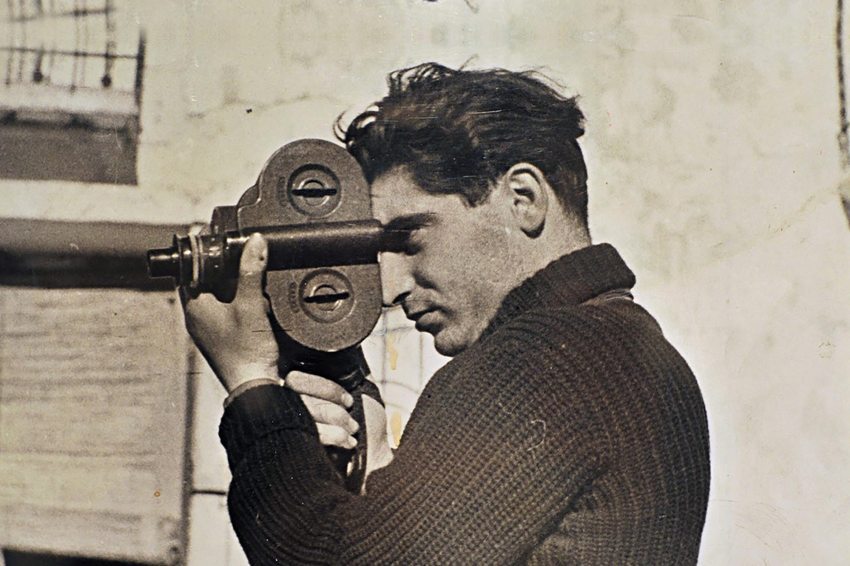
“It’s not enough to have talent, you also have to be Hungarian”, said Robert Capa, the greatest war reporter in the history of photography, born as Endre Ernő Friedmann in Budapest. During his daring and adventurous life, he captured five wars from the firing line, and then, fulfilling his own destiny, lost his life on the battlefield.
Lost his love in the war
The Nobel Prize winner for Literature, John Steinbeck, said of him, “He could photograph motion and gaiety and heartbreak. He could photograph thought.” But Capa was a friend not only of this literary genius but also of another one, Ernest Hemingway, as well as Pablo Picasso and Ingrid Bergman was his love. He managed to condense an incredible amount of human encounters, inhuman moments, creativity, emotion, and drama into 41 years, and he did not take them with him to his grave but left them to posterity in the photographs he made.
Born in 1913, his father was a dressmaker, he wanted to become a writer, but he was captivated by photography and eventually stayed with that. In fact, it was his first love that laid the foundations for his “eternal love”, as he began to learn his photography following Éva Besnyő, who would later become an internationally renowned photographer. Éva later recalled that she also played a big role in choosing the legendary artist’s name: “We called him Cápa („Shark”) at home and his brother Kornél Krokodil (“Crocodile”)” she said – but others say otherwise.
Endre moved to Germany in 1931 and enrolled at the German Political College in Berlin to study journalism. The background to this was that he had sympathized with the illegal Communist Party in Hungary, which had led to trouble with the police, so his parents thought it better to continue his studies abroad. Berlin in the 1930s, however, did not bode well for him as a Jew, although he did achieve his first successes: he joined the Dephot photo agency and produced a memorable series of photographs of Trotsky‘s visit to Denmark.
 Hungaricum laude