

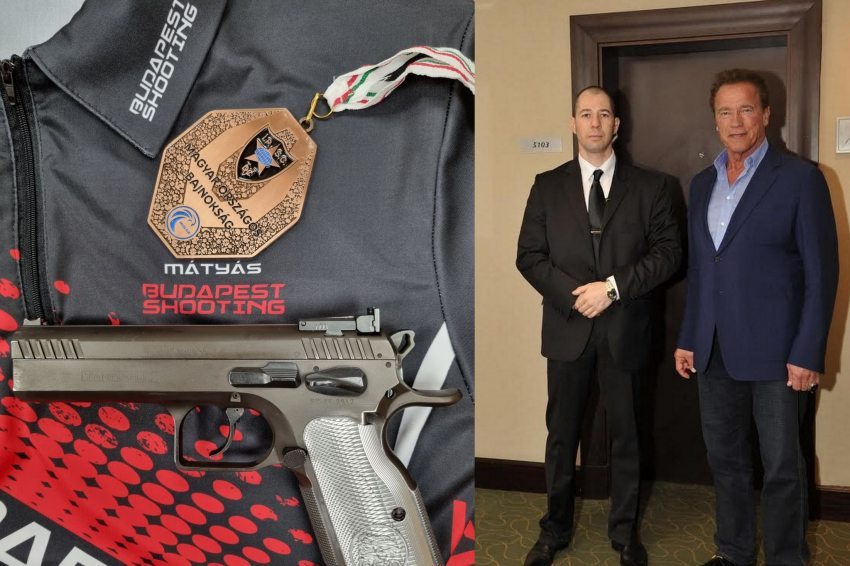
He was bullied as a child and enrolled in martial arts at the age of 14 to protect himself later in life. And – he didn’t know it at the time – others. In most of the sports in which he immersed himself, he didn’t even stop until the instructor level; he became the best in Hungary at knife hand-to-hand combat and in “the Formula 1 of shooting”. And speaking of Formula 1, as a bodyguard, he first accompanied world champion racing driver Fernando Alonso and then went on to work alongside Arnold Schwarzenegger. But how does a Hungarian boy become the bodyguard of The Terminator? Mátyás Tóbiás tells us.
I would have thought you were a lively, feisty little kid. Am I wrong?
I was obedient rather, and patient. My parents worked as teachers and I was often picked on by other children, so I vowed to learn to defend myself. However, at home I was always told to study, to stop playing sports, that’s for Olympians. One day, I saw the dragon logo of the Kelemen István Jiu-Jitsu Hall on Madách Square and started to train there. At 14, I was already big in the children’s group, so they put me in the adult group where I got beat up very badly. But I didn’t give up, I kept reading martial arts books like the Bible. Two years later I switched to aikido, the first sport I became an instructor of.
Why was it important for you to volunteer in the army in the meantime?
I needed the challenge to toughen me up. At the time I even thought I was going to be a detective or a professional soldier. I requested to be placed in Pécs, to join the Depth Reconnaissance Squadron, which had been defending the border from the South Slavic war not long before, but I also trained with the legendary Kálmán Furkó in Szolnok. Without him I wouldn’t be here today, he didn’t tolerate compromise, but if you did what he asked you to do, you could leave. I learned hand-to-hand combat and parachuting, and I realized that real combat is different from idealized martial arts. The latter is a kind of inner path to spiritual peace, considered by many to be more art than combat. I think everyone gains as much from it as they understand. Those who go to Tai Chi will not become fighters, those who go to Thai boxing are obviously interested in competition, not enlightenment. One is health promotion, the other is results-oriented.
Am I correct that you eventually found your place in the krav maga Israeli self-defense system?
First I was a civilian skydiver, then I worked as a scuba diving assistant for a friend. After skydiving, it was strange to find that I dived more slowly and that while skydiving is a long preparation with short enjoyment, scuba diving is the exact opposite. But I’ve also been a receptionist at the Saudi embassy and armored truck personnel, too. And krav maga really got me with its practicality. The system is also effective because it is still being refined in Israel today. The coaches noticed me right away, and after being the best in the class I became an instructor of it a year later. Meanwhile, I was also the first Hungarian to complete in kettlebell the so-called “Beast Challenge”, which requires you to perform three tasks with a 48 kg iron ball. I trained for 9 months for this, but success was followed by endless emptiness. Since then I have learned – from the Olympians I trained – that professional athletes and even billionaire businessmen go through the same thing after a big result. They reach their goal, but then what?
 Hungaricum laude