

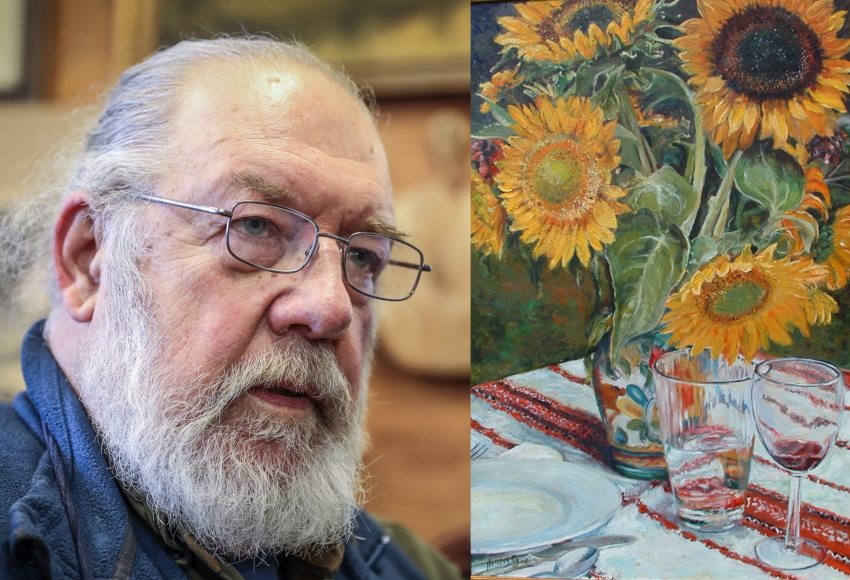
He has never lived in Hungary, yet he speaks our language without an accent, and his Hungarian identity defines his life. Gyuri Hollósy was born in Germany after the Second World War as a child of Hungarian parents with whom he settled in the USA at the age of nine. The sculptor continued the family tradition that made his great-uncles – painters Tivadar Csontváry Kosztka and Simon Hollósy – famous. Among many others, he makes 1956 themed Hungarian sculptures. His studio is decorated with a Hungarian flag and the coat of arms of the Kosztka family. Even his dog (a Puli breed) named Tibor Bartók Csillag is Hungarian. We talked to Gyuri, who lives in New Jersey, about the novel-like life of his ancestors and him, and the message of his works.
– Let’s start with the past! What should we know about previous generations of your family?
– One of my great-uncles was Simon Hollósy on my father’s side, Ervin Simon Hollósy. The other was Tivadar Csontváry Kosztka on my mother’s side, Ilona Erzsébet Kosztka. As famous painters, they were my relatives in their artistic way of life, too. The Kosztka family came to Hungary from Poland in the 17-18th century, and the Hollósys came from Transylvania. My father was born in the village of Petrova, from where the Hungarians were expelled after the First World War. My grandfather was a judge, imprisoned by the Romanians but later released to Eger, Hungary to join his relocated family. My mother was born in Recsk, where they had a prestigious orchard; they also received awards for their fruits. I found a large certificate about this, bigger than my paintings, as I paint, too. And I keep everything that reminds me of what the old Hungarian world was like. My grandfather, on my father’s side, allegedly gave wonderful speeches and even wrote down the stories of his life on an old typewriter. Everyone thought these writings were lost, but I found them in the parental house. I remember them because my father read these to me as a child. I still have them; you can get insight from them about my grandfather’s adventurous life and the historical changes of the early 20th century. I also took a copy of it to my father’s siblings in Hungary.
– When and where did your parents get married, and why were you born in Germany?
– They got married in Hungary during the Second World War. My brother, László, was born in 1944, but unfortunately, he died at the age of six months. I was born in 1946 in Germany, where my parents emigrated for political reasons. In Germany, my father became the leading producer and announcer of Radio Free Europe. Since my grandparents stayed at home, my grandfather always wrote to my father whenever he heard him on the radio. Of course, he sent his letters in coded language because they didn’t know who could see their correspondence. When the radio was looking for a child voice for a play, I was even given a role. My father spoke German well and later had perfect English pronunciation, but he couldn’t put the sentences together correctly in English. My mother put them together well, but her pronunciation was funny, so many times, I translated what they said. We stayed in Munich until we received a report in 1955 from the U.S. Consulate that they were going to close the borders for ten years, so if we wanted to emigrate, we needed to go that year. And we went. Then, in 1956, almost 300,000 Hungarians came after us; fortunately, they were accepted as well.
 Hungaricum laude